
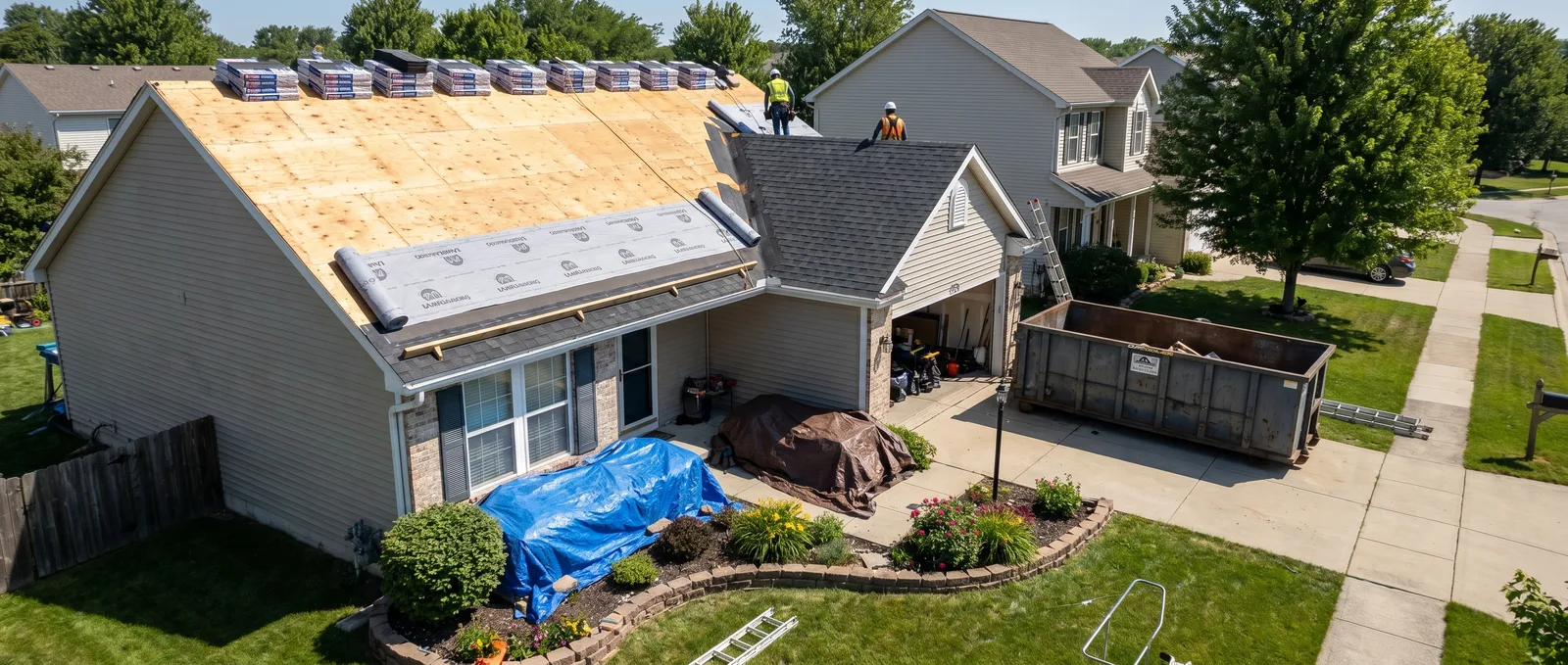
If you've never had a roof replaced before, the process can feel opaque. How long will it take? Will I need to leave the house? What about my landscaping? When does materials show up?
This guide walks through a typical North Georgia roof replacement project from start to finish, both for cash-paying customers and for insurance claim projects (which take longer). It's based on hundreds of projects we've completed across Forsyth, Hall, Gwinnett, Fulton, Jackson, and Barrow counties.
Two timelines: cash vs insurance
Cash projects (you're paying out of pocket without an insurance claim) and insurance projects (carrier is paying for storm damage) follow different schedules. Most of the difference is in the front half. Actual installation is similar.
| Phase | Cash project | Insurance project |
|---|---|---|
| Inspection & quote | 1-3 days | 1-3 days |
| Insurance claim & adjuster | N/A | 2-4 weeks |
| Contract & deposit | Same day to 1 week | After claim approval |
| Materials delivery & scheduling | 1-3 weeks | 1-3 weeks |
| Installation | 1-2 days | 1-2 days |
| Final inspection & paperwork | 1-3 days | 1-3 days |
| Depreciation release (insurance) | N/A | 2-4 weeks after completion |
| TOTAL TIMELINE | 2-4 weeks | 4-10 weeks |
Phase 1: Initial inspection and quote (1-3 days)
The process starts with a free inspection. We schedule typically within 24-48 hours of your call. The inspection itself takes 30-45 minutes:
- We walk the roof (weather permitting) or use drone photography
- We document the condition of every slope, valley, and penetration
- We measure the roof to the square foot
- We check attic ventilation and any visible decking from the attic side
- We discuss your goals (full replacement vs repair, shingle preferences, color choices)
You'll receive a written quote within 1-3 business days, usually with two or three options at different price points (e.g., GAF Timberline HDZ baseline, GAF Timberline UHDZ upgrade, GAF Designer line for premium homes).
Phase 2 (insurance only): claim filing and adjuster meeting (2-4 weeks)
If your project is going through insurance, this phase doesn't apply to cash customers. For storm damage:
- You file the claim with your carrier (we can assist with the documentation)
- The carrier assigns an adjuster, typically scheduled within 7-10 business days
- We meet the adjuster at your property to inspect together. This is the most important step in the entire process
- The adjuster issues a scope and ACV (initial) check, usually within 1-2 weeks of the inspection
If the scope is acceptable, we proceed to contract. If not, we submit a supplement request for missed damage, adding 1-3 weeks to the timeline.
Read more about filing an insurance claim if you're early in this process.
Phase 3: Contract signing and deposit (1 day)
Once you've decided to move forward, we sign a contract that specifies:
- The exact shingle product and color
- Underlayment specifications
- Scope of additional work (decking replacement allowance, gutter work, ventilation upgrades)
- Total project cost
- Payment schedule
- Manufacturer and workmanship warranty terms
- Estimated start date
Standard payment structure: small deposit (10-25%) at contract signing, balance due upon completion. For insurance work, the structure is typically deposit + balance after carrier release of depreciation.
Phase 4: Materials ordering and scheduling (1-3 weeks)
Once the contract is signed:
- We order materials specifically for your project (custom orders for designer lines or unusual colors take longer)
- We pull the building permit
- We schedule the install crew based on the next available slot, usually within 1-3 weeks
- We confirm the schedule with you 3-5 days before start
Weather can shift the schedule. We don't tear off a roof if the forecast shows rain within the work window. If a project gets pushed by weather, we typically reschedule for the next clear day, often within a week.
Phase 5: Day before installation
The day before work starts:
- Materials are delivered and staged in your driveway (we use plywood to protect the driveway surface)
- Dump trailer is delivered if needed
- Work crew is briefed on project specifics
- You should: move vehicles out of the driveway, remove items from the porch and walkways, take down or secure any items hanging on exterior walls (mirrors, photos, fragile decor. Vibration can dislodge them during tear-off)
Phase 6: Day 1 of installation (the loud day)
This is the messy day. Most of the disruption happens on day one:
- 7 AM: Crew arrives. Tarps go down to protect landscaping. Foreman walks the site with you to confirm scope.
- 7:30 AM - noon: Tear-off. Old shingles, underlayment, and damaged components are removed and dumped. Expect lots of noise: hammering, prying, debris falling into the dump trailer.
- Noon: Decking inspection. We check every square foot of decking for soft spots or rot. Any damaged decking is replaced before we proceed (this is when the decking allowance from your contract gets used).
- 1 PM - 5 PM: Underlayment installation. Synthetic underlayment goes down across the field, ice and water shield in valleys and at eaves, drip edge along all eaves and rakes.
- 5 PM: If shingle installation hasn't started yet, the roof is now weatherproof under the underlayment. The crew sweeps the property with a magnetic sweeper to pick up nails and debris, then leaves for the day.
From inside the house: expect loud impact noise from 7 AM to about 4 PM. Pets typically need to be in interior rooms, not near the affected slopes. Conversations on phone calls and video meetings are difficult during peak work, most of our customers either work elsewhere on installation day or schedule lighter work.
Phase 7: Day 2 of installation (the quiet-er day)
Day 2 is shingle installation:
- 7 AM: Crew arrives
- 7:30 AM - early afternoon: Shingles are installed slope by slope, starting with the lowest courses and working up to the ridge. Pneumatic nailers are loud but not as relentlessly loud as tear-off.
- Afternoon: Ridge cap installation, ridge vent, flashings, pipe boots
- End of day: Final cleanup. Magnetic sweeper across the entire perimeter and yard. Dump trailer is hauled away. Final walkthrough with you to confirm completion.
For most homes (28-30 squares), the entire installation is complete by end of day 2. Larger or more complex roofs may extend into day 3.
Phase 8: Final inspection and paperwork (1-3 days)
After completion:
- City/county inspector visits to confirm permit compliance (usually within 1-3 days)
- We submit final paperwork and photos to your insurance carrier (for insurance claims)
- We register your manufacturer warranty with GAF
- We schedule a follow-up nail sweep within 7-14 days for any nails missed by the magnetic sweeper
Phase 9 (insurance only): depreciation release
For insurance projects, the carrier releases the depreciation portion of your claim 2-4 weeks after we submit final completion paperwork. This is the "second check" on RCV policies. Once you receive it, you forward it to us for the balance of the project cost.
If you have questions about ACV vs RCV, that guide explains how the two checks work.
What can go wrong (and how we handle it)
Weather delays
Rain or storms during a tear-off can extend the project by a day or two. We tarp exposed areas and resume when weather clears. This rarely affects total project cost.
Decking damage discovered mid-project
About 30% of replacements involve some decking replacement (rotted or soft plywood). Your contract should include an allowance for X squares of decking replacement at a per-square cost. Beyond that allowance, additional decking is billed separately. We document with photos before installing new decking.
Materials backorder
Rare, but designer lines and unusual colors occasionally have 2-4 week wait times. We disclose any backorder concerns at contract signing.
Insurance supplement issues
If the adjuster scoped only partial replacement and full replacement is needed (for code or matching law reasons), we submit a supplement. The carrier typically responds within 1-2 weeks, then approves or denies. Approval extends the timeline by 2-3 weeks total; denial means we need to file a formal appeal.
What to expect afterward
- Week 1-2: Some lingering granule wash-off from the new shingles during rain. Normal. These are manufacturing fines that shed in the first cycle.
- Week 2-4: Sealant strips on the shingles fully bond as temperatures rise. The roof reaches its full wind rating after this period.
- Year 1: Inspect once at the 12-month mark to confirm everything is settled. Most contractor warranties have a year-one walkthrough.
- Years 2-5: Annual visual inspections recommended; occasional minor maintenance like keeping gutters clear and trimming branches.
- Years 5-10: First flashing replacements may be needed (boots and pipe flashings have shorter lives than shingles).
- Years 10-22: Roof performs as designed; occasional storm damage may require repairs.
- Year 22+: Plan for next replacement; see our lifespan guide.
The bottom line
A typical North Georgia roof replacement is a 2-4 week project end to end (cash) or 4-10 weeks (insurance), with 1-2 days of actual roof work. Plan around the loud installation days, but don't expect to need to leave your home. Communicate clearly with your contractor about scheduling, scope, and expectations, most issues during projects come from misalignment on these things rather than installation problems.
If you're planning a replacement and want a clear sense of the timeline for your specific project, give us a call. We'll walk you through the schedule from start to finish before you sign anything.
Frequently asked questions
How long does a roof replacement take from start to finish? +
From signing the contract to completed work, expect 1-4 weeks for cash projects, 4-10 weeks for insurance claim projects. The actual installation is typically 1-2 days. Most of the timeline is scheduling, materials delivery, and (for insurance work) carrier processing.
Will I need to leave my home during the replacement? +
No. Roof replacements are noisy and disruptive but homeowners stay in the house. Plan for: nail-gun noise from 7 AM until late afternoon for 1-2 days, occasional debris falling on flower beds and walkways, and a temporary staging area for materials in the driveway. We protect landscaping, but having sensitive items moved off the porch and away from windows is helpful.
Can it rain during a roof replacement? +
Generally no. We don't tear off a roof if rain is forecast within the work window. If weather changes mid-project, we tarp the exposed sections and resume when the weather clears. Underlayment provides additional protection while shingles are being installed. We've never had interior water damage from a project we managed start-to-finish.
What about my plants, lawn, and driveway? +
We protect landscaping with tarps and physical barriers, place dump trailers on plywood to prevent driveway damage, and run a magnetic sweeper across the lawn at the end of each day to pick up loose nails. Some debris is unavoidable in flower beds, and we hand-pick larger pieces, but tiny granules and roofing fragments may persist for several days afterward and wash away with the next rains.
Will I need to be home during the work? +
Not necessarily. We need someone present at the project start (to confirm scope and material delivery) and at the project end (final walkthrough). The middle days, you can come and go normally. Many of our customers work from home during projects with no significant disruption. It's loud but the work is outside.