
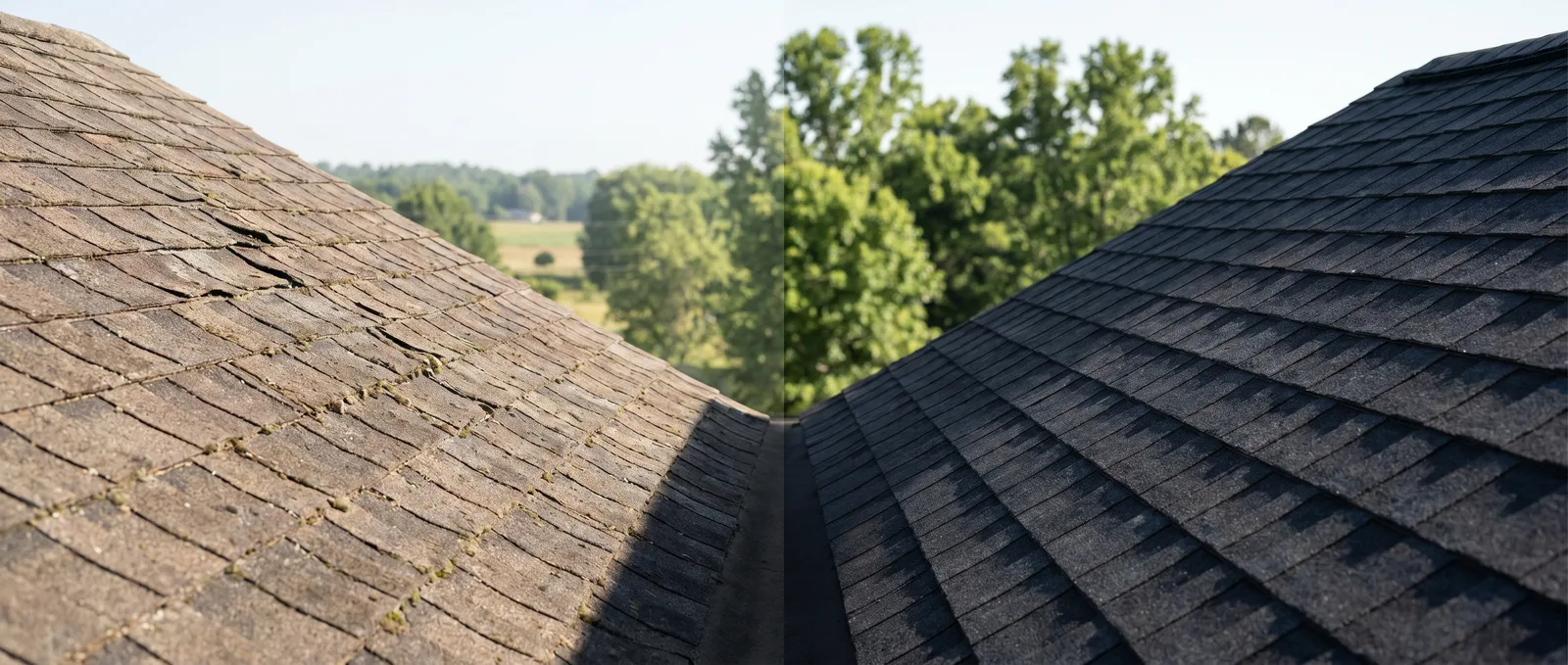
You've probably seen the manufacturer claims: "Lifetime architectural shingles. 50-year warranty. Engineered to last." Then you talk to your neighbor whose roof is 18 years old and already has visible wear, and you start to wonder which version of reality is true.
Honest answer: both are. Manufacturer warranty terms describe ideal conditions in mild climates. Real roofs in Georgia live shorter lives because Georgia is hard on roofs.
This is a contractor's perspective, based on hundreds of inspections across North Georgia, on how long roofs actually last here, why, and what you can do about it.
Real-world lifespan by roofing material
| Material | Manufacturer claim | Real Georgia lifespan | Premium quality lifespan |
|---|---|---|---|
| 3-Tab Asphalt Shingles | 20-25 years | 15-18 years | 18-20 years |
| Architectural Asphalt | 30-50 years | 22-28 years | 28-32 years (impact-rated) |
| Designer/Luxury Shingles | Lifetime | 28-35 years | 35-40 years |
| Standing Seam Metal | 40-70 years | 40-50 years | 50-60+ years |
| Stone-Coated Metal | 50 years | 35-45 years | 45-50 years |
| Concrete Tile | 50+ years | 40-50 years | 50-60 years |
| Slate (real) | 100+ years | 75-100 years | 100+ years |
For asphalt shingles in Georgia, real lifespan is roughly 70-75% of the warranty claim. A "30-year" architectural shingle gives you around 22-23 years before it needs replacement. A "50-year" lifetime shingle gives you 28-32 years. Plan accordingly.
Why Georgia is hard on roofs
Manufacturer warranties are calibrated using accelerated weathering tests in laboratory conditions. Those tests model average North American conditions. Georgia is significantly harsher in three specific ways:
1. UV intensity and heat
Georgia summers regularly hit 95°F+ with intense UV. Shingle surface temperatures on a hot afternoon can reach 150-160°F, well above the threshold where asphalt begins to soften and oxidize. Over decades, this cumulative heat exposure breaks down the asphalt binder, leading to brittleness, cracking, and granule loss.
The same shingle in Minnesota or Pennsylvania faces fewer 90°F+ days per year. That's why a 30-year shingle in Pittsburgh can hit its rated life and a 30-year shingle in Atlanta typically can't.
2. Storm exposure
Georgia's storm exposure is well above national average. Hail events, severe thunderstorms, occasional hurricanes, and tornadic activity all damage roofs. North Georgia specifically sees hail-bearing storms several times per year. The April 10, 2025 storm and August 30, 2024 hail event are recent examples.
Each major storm event removes some granules, opens some shingle seals, and stresses some flashings. The cumulative effect of 5-7 major storms over a roof's life is significant.
3. Humidity and biological growth
Georgia's humidity creates ideal conditions for algae (Gloeocapsa magma), those black streaks you see on aging roofs. Algae itself is mostly cosmetic, but the moisture environment that supports algae also supports lichen growth and underlayment decay. Roofs in dryer climates simply don't experience this in the same way.
4. Pollen and debris loading
North Georgia's spring pollen season covers everything in yellow dust, including roofs. Pollen mixed with rainwater creates a mildly acidic film that wears at shingle surfaces. Heavy oak and pine pollen years are noticeably harder on roofs than mild ones.
What ages a roof faster
Even within Georgia, some roofs age faster than others. The biggest factors:
- Poor attic ventilation. Trapped attic heat raises shingle temperatures from below, baking them year-round. Inadequately vented roofs can lose 5-7 years of life. We assess ventilation on every inspection.
- South- and west-facing slopes get more sun than north- and east-facing ones. We routinely see one slope of a roof needing replacement while the others have years of life left.
- Tree cover. Heavy tree shade extends shingle life by reducing UV. But trees also deposit debris that traps moisture against the shingle surface. Net effect varies. Light dappled shade is ideal; full shade with heavy debris is actually worse than full sun in some cases.
- Original installation quality. Improper nailing patterns, wrong nail length, missing starter strip, inadequate ice and water shield, all of these shorten roof life dramatically. A poorly-installed premium shingle dies before a properly-installed mid-grade one.
- Roof pitch and complexity. Steep roofs with complex valleys, dormers, and penetrations have more potential failure points. Simple gable roofs with few penetrations age more gracefully.
Signs your roof is approaching the end of its life
Even without specific storm damage, an aging roof tells you it's done. Look for:
- Curling or cupping shingle edges: the asphalt has lost its flexibility
- Granule loss across all slopes: visible bare spots, granules accumulating in gutters
- Cracked or missing shingles beyond what storm damage would explain
- Sagging rooflines: usually indicates underlying decking failure
- Multiple leak repairs in different locations: when leaks become a pattern, full replacement is more economical than repairs
- Daylight visible from the attic: gaps in the roof membrane
- Shingles sliding out of position: sealant strips have failed
If your roof is 18+ years old (asphalt) and showing two or more of these signs, it's likely past replacement time. We've outlined a more complete checklist in our 5 signs you need a new roof guide.
Can you extend a roof's life?
Yes, modestly. The biggest gains come from:
Maintaining proper attic ventilation
Adequate ridge venting paired with intake venting at the eaves can reduce attic temperatures by 20-30°F in summer. That alone can add 3-5 years to shingle life. We assess ventilation on every replacement and add or upgrade where needed.
Keeping gutters clean
Clogged gutters cause water to back up under shingles, degrading the underlayment and rotting decking. Keep them clear, especially in fall when pine straw and oak leaves dominate North Georgia gutters.
Addressing leaks immediately
A small leak that gets repaired this year is a $300 problem. The same leak ignored for 18 months is a $4,000 decking and underlayment replacement. Don't wait.
Trimming overhanging branches
Branches abrading shingles in wind cause accelerated granule loss. Cut anything that's actually contacting the roof, and trim branches that drop heavy debris onto roof surfaces.
Algae prevention with zinc strips
Installing a zinc strip near the ridge causes zinc oxide to wash down across slopes during rain, which inhibits algae growth. This is mostly cosmetic but extends the period during which the roof looks new.
What lifespan should you actually plan around?
For a typical North Georgia home with architectural asphalt shingles installed properly with adequate ventilation:
- Years 0-15: roof performs as designed, minimal maintenance
- Years 15-22: occasional minor repairs may be needed; storms more likely to cause damage
- Years 22-28: visible aging; plan for replacement; closely monitor after storm events
- Years 28+: replacement is overdue; risk of catastrophic leak failure increases each year
If you bought your home with an existing roof and don't know its age, get a free inspection. We can usually estimate age within 3-5 years and give you an honest sense of how much useful life remains.
The bottom line for Georgia homeowners
Plan for roof replacement around year 22-25 for architectural asphalt, year 16-18 for 3-tab. Invest in quality installation more than premium materials. A well-installed mid-grade roof outperforms a poorly-installed premium one. Keep up basic maintenance. Address storm damage promptly when it occurs. And don't trust the warranty alone to tell you how long your roof will actually last.
If you're not sure where your roof stands, schedule a free inspection. We'll give you an honest age estimate, identify any near-term issues, and tell you whether replacement is approaching or still years away.
Frequently asked questions
How long does an asphalt shingle roof last in Georgia? +
Architectural asphalt shingles typically last 22-28 years in Georgia, even though manufacturer warranties claim 30-50 years. Georgia's heat, humidity, and storm exposure cut roughly 15-25% off the rated lifespan. 3-tab shingles last 15-18 years here. Premium impact-rated lines can reach 28-32 years.
Do darker shingles fail faster in Georgia? +
Yes, modestly. Dark shingles run 10-20°F hotter on a Georgia summer afternoon than light shingles, which accelerates the breakdown of the asphalt mat. The difference is typically 1-3 years of useful life over a 25-year span. Color choice is mostly aesthetic, but lighter colors do hold up slightly longer.
Why do roofs in Georgia fail before their warranty expires? +
Two main reasons. First, heat and UV exposure are far harsher in Georgia than in the Northeast and Midwest, where most shingle warranties are set. Second, Georgia gets frequent severe storms, hail and high winds shorten roof life every time they hit. A 'lifetime' warranty doesn't cover storm damage, only manufacturing defects. Most Georgia roofs need replacement well before the warranty's stated end.
How can I tell what year my roof was installed? +
Check your home's purchase records (the seller usually disclosed roof age) or check city/county permit records, most North Georgia counties keep online permit history searchable by address. If you bought the home with the existing roof, the previous owner's disclosure or the home inspection report should note the age. We can also estimate roof age within 3-5 years during a free inspection based on shingle wear patterns.
Can I extend my roof's life with maintenance? +
Yes, modestly. The biggest factors are: keeping gutters clean (clogged gutters back water under shingles), addressing leaks immediately (small leaks become big repairs), maintaining attic ventilation (heat shortens shingle life from below), and trimming overhanging branches (debris accelerates wear and granule loss). Good maintenance can add 2-4 years to a typical Georgia roof's life.