
Roof Replacement
Full tear-off & GAF system installation
The components that determine whether your roof actually lasts its rated life. Inadequate ventilation cooks shingles from below; failed flashing causes most leaks. We handle both as core parts of every project, not afterthoughts.
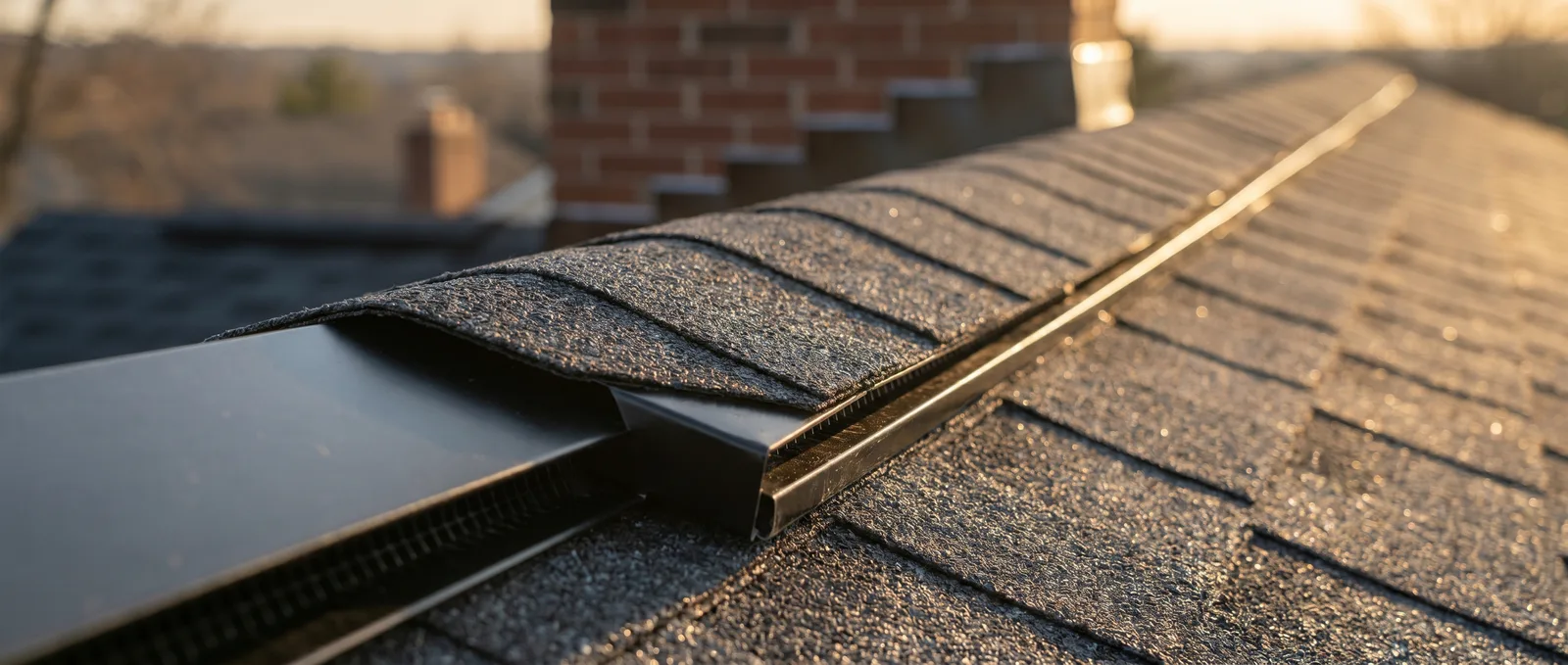
Most homeowners think a "roof" is the shingles. In reality, shingles are just the visible surface of a roofing system. The two components that quietly determine whether that system performs are attic ventilation and flashing. Get them right and a mid-grade shingle outlasts its warranty. Get them wrong and a premium shingle fails years early. After hundreds of roof replacements and leak repairs across North Georgia, we can tell you with confidence: these aren't add-ons.
Attic temperatures in Georgia summers regularly exceed 130°F when ventilation is undersized. That heat radiates upward into the underside of your shingles, accelerating the breakdown of the asphalt mat. We routinely see roofs that should have lasted 28 years failing at 18-20 because the attic was a furnace year-round. Properly vented attics in our climate run 20-30°F cooler, meaningful enough to add 5-7 years to typical shingle life.
Beyond shingle life, undersized ventilation contributes to:
A working ventilation system needs both intake and exhaust. Air enters at the eaves through soffit vents and exits at the highest point through ridge vents. The ratio matters: code calls for roughly 50/50 intake-to-exhaust, with total net free area equal to 1/150 of the attic floor (or 1/300 if a vapor barrier is in place). Most homes we inspect are out of balance, typically too much exhaust and not enough intake, which makes the ridge vents pull conditioned air from the living space below rather than from outside.
If we had to bet on where your next leak will originate, we'd bet on flashing, not shingles. Roughly 90% of the leak repairs we perform trace back to a failed flashing component, not a damaged or missing shingle. Water finds the weakest seam in the system, and seams are exactly what flashings exist to seal.
The flashing components on a typical North Georgia home:
Every roof replacement we perform includes the full ventilation and flashing system as standard, not as an add-on or upgrade. Specifically:
Some lower-priced roofing quotes save money by reusing existing flashings or skipping ridge vent upgrades. When comparing estimates, ask specifically what's included beyond the shingles themselves. The difference between a roof that lasts 25 years and one that fails at 15 is usually the flashing, not the shingles.
Several scenarios bring homeowners to us thinking they need a new roof when the actual issue is something simpler:
We do honest inspections. About 30% of the leak inspections we run identify a flashing fix that costs a fraction of replacement. We'd rather earn a customer's trust on a $400 repair than push them into a roof they don't yet need. Read more about our leak detection & repair services →
Free inspection. We'll tell you whether the fix is small or large, honestly.
Common questions about attic ventilation, flashing, and pipe boots.
A few signs that your ventilation is undersized: the attic feels significantly hotter than outside on summer afternoons (more than 20°F warmer), shingles on south- and west-facing slopes are aging faster than the rest of the roof, you have ice damming in winter despite a well-insulated attic, or your second-floor rooms are noticeably harder to cool. Code-minimum ventilation is 1 square foot of net free area per 150 square feet of attic floor, balanced 50/50 between intake (soffit vents) and exhaust (ridge vent). We measure both during a free inspection.
Yes. Ridge venting can be retrofitted onto an existing roof, we cut a continuous slot along the ridge, install the ridge vent component, and re-shingle the ridge cap. Cost is typically $400-$900 depending on roof length. The catch: ridge venting only works if you have adequate intake at the eaves (soffit vents). Adding ridge venting without intake just creates negative pressure that pulls conditioned air out of your living space, which makes things worse, not better. We always assess the full system before adding ventilation.
Step flashing is the L-shaped pieces installed along walls or chimneys at every shingle course, weaving in with the shingles to direct water away. Counter flashing is the cap piece (typically embedded in masonry mortar joints on chimneys) that overhangs the step flashing and prevents water from getting behind it. A properly flashed chimney has both: step flashing tying into the roof, counter flashing tying into the masonry. When either is damaged or improperly installed, leaks follow.
Pipe boots, the rubber gaskets around plumbing vents that exit your roof, typically last 7-12 years in Georgia. The rubber dries out from UV exposure, cracks, and starts leaking. Pipe boots are one of the most common single causes of roof leaks. The fix is fast and inexpensive (about $150-$300 per boot replaced) but needs to happen before the leak causes interior damage. We replace all boots as part of any roof replacement, and offer boot-only replacement as a standalone service.
In our installations, yes. Every roof replacement we perform includes new ridge venting (or upgraded venting where existing was inadequate), new step flashing at all walls and chimneys, new drip edge along eaves and rakes, new pipe boots on all penetrations, and an assessment of soffit intake with recommendations if it's undersized. Some lower-priced roofing quotes leave these out or reuse existing components, when comparing estimates, ask specifically what's included beyond the shingles themselves.
Full tear-off & GAF system installation
Find the source, not just the symptom
Free inspection & insurance documentation
5" and 6" seamless gutter systems