
Here's something most homeowners never hear until it's too late: shingles don't just wear out from the top. In Georgia, a huge share of premature roof failures start underneath, in an attic that traps heat and moisture because nobody ever gave the ventilation a second thought.
We see it constantly on inspections. A roof that should have 8 good years left is curling and brittle at year 15 because the attic below it has been running at 140-160°F every summer for a decade. The homeowner paid for a 30-year shingle and got a 15-year result, and the shingle itself was never the problem.
This guide covers how attic ventilation actually works, why Georgia's climate punishes bad ventilation harder than almost anywhere else, the warning signs you can check yourself, and what fixing it costs. It's shorter money than you'd think, and it's one of the highest-return investments you can make in your roof.
How roof ventilation actually works
A ventilation system has two halves, and both have to work for either to matter:
- Intake pulls fresh outside air in low, through vents in the soffits (the underside of your roof overhangs).
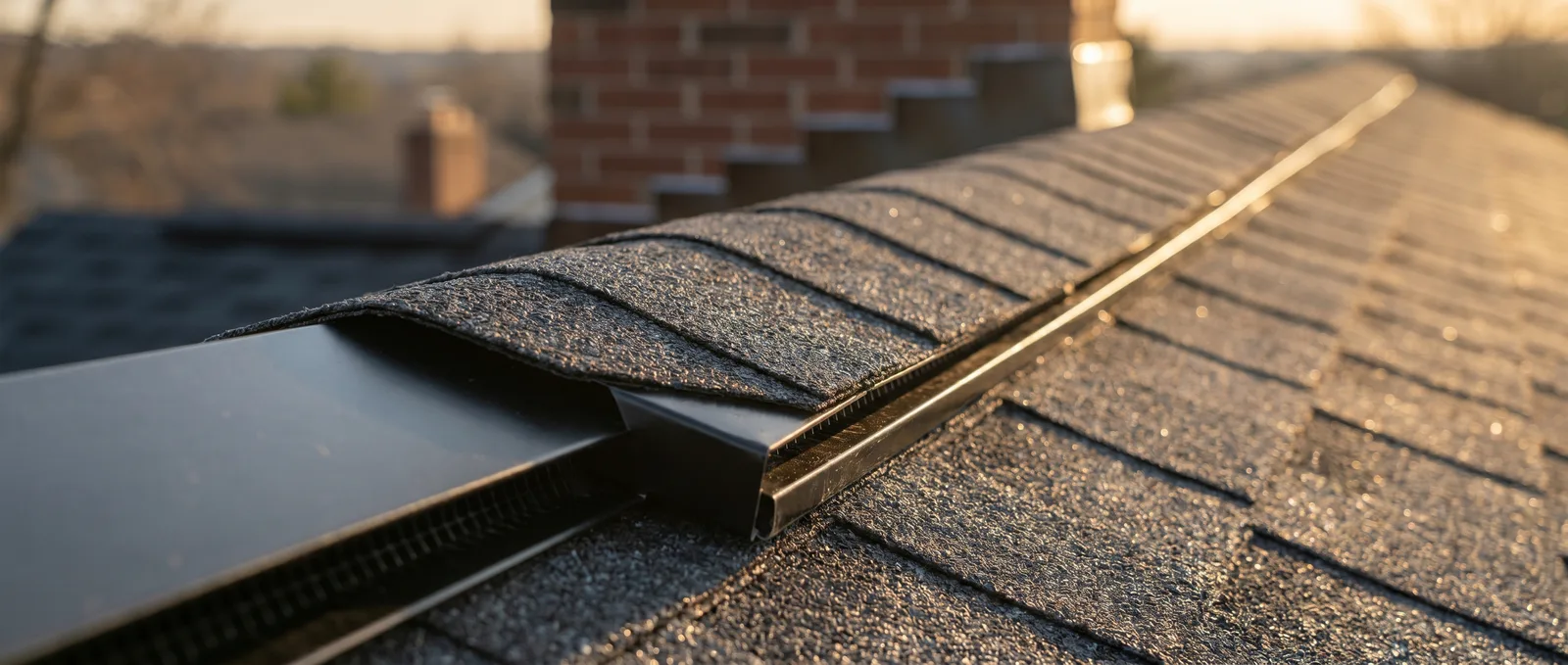
- Exhaust releases hot, moist air up high, most commonly through a continuous ridge vent along the peak, or through box vents or a power vent.
Cool air enters at the eaves, warms as it rises, and exits at the ridge. That steady convection loop is what keeps an attic within a reasonable range of the outdoor temperature. No fans, no electricity, just physics, when it's set up correctly.
The standard most codes and every shingle manufacturer use is the 1/300 rule: 1 square foot of net free vent area for every 300 square feet of attic floor, split roughly half intake and half exhaust. Most under-ventilated homes we inspect fail on the intake side, not the exhaust side. More on that below.
Why Georgia is a worst-case climate for bad ventilation
Two things make Georgia brutal on unventilated attics: heat and humidity, and we have long seasons of both.
Summer: your shingles cook from both sides
On a 95°F August afternoon, a dark roof surface can hit 150-170°F. That's the load shingles are designed to take from above. But if the attic underneath is sealed up and holding 140-160°F of trapped heat, the shingles are now baking from both directions. The asphalt mat dries out faster, granules shed sooner, and the shingle ages years ahead of schedule.
Proper ventilation can hold that same attic 20-40°F cooler. Over a 25-year lifespan, the difference compounds into real years of roof life.
Winter: moisture is the silent one
Georgia winters are mild, but they're damp. Everyday household activity (showers, cooking, laundry, breathing) pushes moisture-laden air up into the attic. In a ventilated attic, that moisture rides the airflow out the ridge. In a sealed attic, it condenses on the cold underside of the roof decking.
Wet decking grows mold, delaminates, and loses the ability to hold nails. We've torn off roofs where the shingles looked passable from the street but the decking underneath was soft enough to press a thumb into. That's a ventilation failure, and it turns a standard replacement into a replacement plus thousands of dollars in new decking.
What poor ventilation costs you
| Consequence | How it happens | What it costs you |
|---|---|---|
| Premature shingle failure | Trapped attic heat bakes shingles from below | 5-10 years of lost roof life |
| Rotted roof decking | Winter condensation soaks the underside of the plywood | $2,000-6,000+ in decking at replacement time |
| Voided shingle warranty | Manufacturers require code-level ventilation | Denied claim on a defect that should've been covered |
| Higher cooling bills | A 150°F attic radiates heat through your ceiling all day | Noticeably harder-working AC, June through September |
| Mold and air quality issues | Chronic attic moisture with nowhere to go | Remediation costs and potential health concerns |
The warranty fine print
GAF and every other major shingle manufacturer condition their warranties on adequate attic ventilation. If a shingle fails early and the inspection finds an under-ventilated attic, the claim can be denied outright. We've seen homeowners lose coverage on legitimate material defects for exactly this reason. It's the cheapest warranty protection there is: get the ventilation right.
Warning signs you can check yourself
You don't need to climb on the roof. Here's what to look for:
- Your upstairs is hot long after sunset. A sealed attic holds its heat for hours and radiates it down into bedrooms all evening.
- The ceiling feels warm to the touch on a summer afternoon. Insulation slows heat, but a 150°F attic wins eventually.
- Soffit vents that are painted over, clogged, or buried. Walk your home's perimeter and look up at the overhangs. If you see vents caked in paint or dirt, intake is compromised. Inside the attic, insulation pushed tight against the eaves blocks airflow the same way.
- Rust on nail tips or dark staining on the decking visible from inside the attic. Both are moisture signatures.
- A musty smell in the attic, especially in winter. Healthy attics smell like wood and dust, not damp.
- Curling or blistering shingles on a roof under 15 years old. Age does this eventually. On a young roof, heat from below is the usual suspect.
Exhaust options: ridge vents vs box vents vs power vents
| System | How it works | Our take |
|---|---|---|
| Continuous ridge vent | A low-profile vent running the full length of the peak, covered by cap shingles | Best option for most homes. Even airflow, no moving parts, nearly invisible from the street. This is what we install on almost every replacement. |
| Box (static) vents | Individual square vents cut near the ridge | Functional but less effective. Each one is also a penetration that can eventually leak. Fine on roof shapes where a ridge vent won't work. |
| Power attic vents | An electric or solar fan that forces air out | Strong on paper, problematic in practice. Motors fail within 5-10 years, and a powerful fan with weak soffit intake will pull conditioned air out of your living space instead. We rarely recommend them. |
| Gable vents | Louvered vents in the gable end walls | Common on older North Georgia homes. They ventilate side to side rather than bottom to top, and they can short-circuit a ridge vent system. Often better closed off when a proper intake/exhaust system is installed. |
The intake side: where most homes actually fail
Homeowners and even some contractors obsess over exhaust and forget that exhaust can't work without intake. A ridge vent with blocked soffits is like a straw with your thumb over the end.
The most common intake problems we find in North Georgia attics:
- Insulation blocking the eaves. Blown-in insulation drifts into the soffit bays and chokes off airflow. The fix is insulation baffles (rigid channels stapled between rafters that keep an air path open), and it's inexpensive.
- Decades of paint on perforated soffit vents. Three or four repaints can close most of the perforations. Look closely at older aluminum soffits.
- Solid soffits with no vents at all. Common on homes from the 60s through the 80s. Retrofitting vented soffit panels or adding intake vents solves it.
When we do a ventilation assessment, intake is the first thing we check, because it's the failure point in the majority of under-performing systems.
What fixing it costs
The good news: ventilation is one of the cheapest components of a roofing system to correct.
- Clearing blocked intake and adding baffles: typically $300-800
- Adding a ridge vent to an existing roof: typically $500-1,500 depending on ridge length
- Full intake and exhaust correction: rarely more than $2,000 on a typical home
- During a roof replacement: the marginal cost of doing ventilation right is small, since the ridge is already open and the crew is already there. This is the single best time to fix it.
Compare any of those numbers to losing 5-10 years off a $12,000-20,000 roof, or paying for new decking at tear-off, and the math isn't close.
The bottom line for Georgia homeowners
If your roof is being replaced, insist that ventilation is calculated and corrected as part of the job, not treated as an afterthought. Ask the contractor how they're meeting the 1/300 standard and what the intake plan is, not just the exhaust. If your roof still has years left, spend an afternoon checking the warning signs above, because catching a ventilation problem at year 8 instead of year 15 is worth thousands.
And if you'd rather have a professional set of eyes on it, that's what free inspections are for. We check ventilation on every roof we walk, and we'll tell you honestly whether yours is fine, fixable for a few hundred dollars, or quietly eating your roof from below.
Frequently asked questions
How do I know if my attic is poorly ventilated? +
The easiest checks: touch your ceiling on a hot afternoon (it should not feel warm), look for soffit vents blocked by insulation or paint, and note whether your upstairs stays hot long after sunset. In winter, condensation or frost on the underside of the roof decking is a clear sign. We check ventilation on every free inspection and can tell you within minutes whether your setup meets code.
Can bad ventilation void my shingle warranty? +
Yes. GAF and every other major manufacturer require attic ventilation that meets the FHA 1/300 standard (1 square foot of net free vent area per 300 square feet of attic floor, split between intake and exhaust). If a shingle fails prematurely and the attic is under-ventilated, the manufacturer can deny the claim. This is one of the most common reasons warranty claims get rejected.
How much does it cost to fix attic ventilation in Georgia? +
Most fixes are modest. Clearing blocked soffit vents and adding insulation baffles typically runs $300-800. Adding a ridge vent to a roof that has none usually runs $500-1,500 depending on ridge length. A full intake-and-exhaust correction on a typical North Georgia home rarely exceeds $2,000, and it is usually far less when done during a roof replacement.
Ridge vents vs power vents: which is better for Georgia homes? +
For most homes, a continuous ridge vent paired with open soffit intake is the best system: no moving parts, nothing to fail, and even airflow along the entire ridge. Power vents move more air on paper but they burn out, they can depressurize the attic and pull conditioned air out of the house, and they do nothing when they fail. We install ridge vents on nearly every replacement unless the roof shape rules them out.
Does attic ventilation actually lower cooling bills? +
Modestly, yes. A properly ventilated attic in a Georgia summer runs 20-40°F cooler than a sealed one, which reduces the heat load radiating down through your ceiling insulation. Homeowners typically see a small but real reduction in summer cooling costs. The bigger financial win is roof lifespan: ventilation is cheap, and shingles are not.