If you're getting quotes for a new roof in North Georgia, you'll see two basic asphalt shingle categories on every estimate: 3-tab shingles and architectural shingles (sometimes called dimensional or laminated shingles). They look different, cost different amounts, and last different lengths of time. Choosing between them is one of the first decisions you'll make in any roof project.
This guide explains the real differences between the two, and which one makes sense for which kinds of homes.
Quick comparison at a glance
| Feature | 3-Tab Shingles | Architectural Shingles |
|---|---|---|
| Typical cost (installed, per square) | $300-$450 | $400-$600 |
| Expected lifespan | 15-20 years | 25-30+ years |
| Wind rating (typical) | 60-70 mph | 110-130 mph (up to 150 on premium lines) |
| Weight per square | ~200 lbs | ~300 lbs |
| Manufacturer warranty | 20-25 years (limited) | 30-50 years (limited or lifetime) |
| Color/style options | Limited (basic colors) | Wide (designer styles, color blends) |
| Resale value impact | Neutral | Adds curb appeal, can increase home value |
What's the actual physical difference?
3-tab shingles
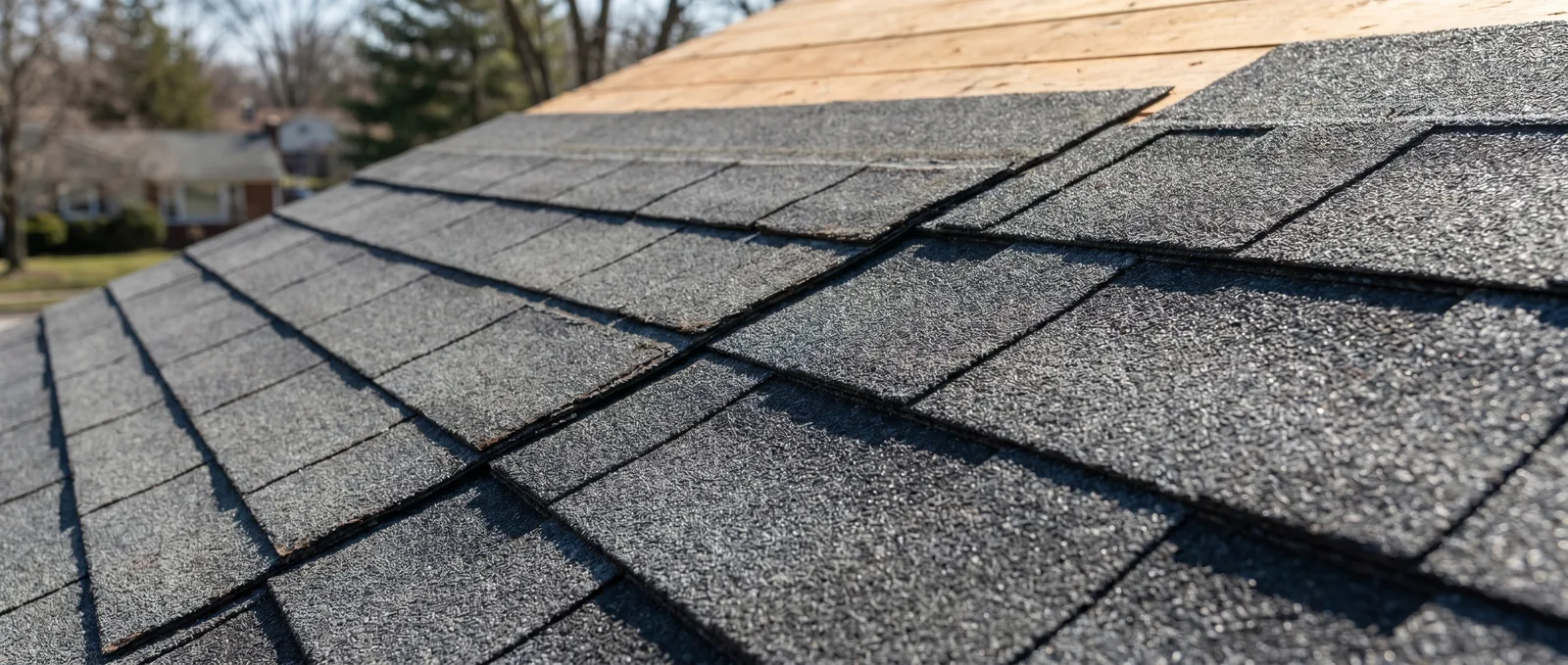
3-tab shingles are flat, single-layer asphalt shingles with horizontal cutouts (slots) that visually divide each shingle into three tabs. They've been the industry standard for decades. The flat profile gives them a uniform, somewhat utilitarian look. They're lighter, cheaper, and easier to install, but also more vulnerable to wind, hail, and the gradual wear of UV exposure.
Architectural shingles
Architectural shingles are made by laminating two or more layers of asphalt mat together, with a textured surface designed to mimic the look of natural materials like wood shake or slate. The result is a thicker, dimensional shingle that creates depth and shadow on your roof. They're heavier, sturdier, and significantly more durable.
Pick up one of each and the difference is immediately obvious. An architectural shingle feels almost twice as substantial as a 3-tab.
Cost: how the math actually works
Architectural shingles cost more up front. For a typical 28-square North Georgia home (a "square" is 100 square feet of roof area), the math looks like this:
- 3-tab installed: ~$8,400-$12,600
- Architectural installed: ~$11,200-$16,800
That's a difference of roughly $2,800-$4,200 to upgrade. The catch: 3-tab lasts 15-20 years; architectural lasts 25-30 years. So:
- 3-tab cost-per-year: $11,000 ÷ 17 years = ~$650/year
- Architectural cost-per-year: $14,000 ÷ 28 years = ~$500/year
Architectural actually costs less per year of useful life, and that math doesn't even account for storm-damage avoidance or the curb appeal/resale value benefit.
In our hail- and wind-prone region, architectural shingles' higher impact resistance often pays back even faster. We see far fewer storm claims on architectural roofs than on 3-tab roofs of similar age, meaning a deductible we never have to pay.
Durability: how each performs in real conditions
Wind
3-tab shingles are typically rated for 60-70 mph sustained winds. Most architectural shingles are rated 110-130 mph, and premium lines like GAF Timberline UHDZ or Owens Corning Duration FLEX go to 150 mph. North Georgia regularly sees wind events in the 50-70 mph range during severe thunderstorms, which puts 3-tab right at its failure point and architectural well within its safety margin.
Hail
The thicker mat in an architectural shingle absorbs hail impact better. Class 4 impact-rated architectural shingles (an optional upgrade with brands like Atlas StormMaster, GAF Timberline IR, or Malarkey Vista AR) can withstand 2-inch hail without damage in lab tests. 3-tab shingles have no comparable impact-rated upgrade, they all perform at roughly the same Class 1 level.
UV and heat
Both types are vulnerable to UV degradation, which is why Georgia heat shortens shingle life compared to cooler climates. Architectural shingles last longer here primarily because their thicker mat takes longer to fully degrade, not because they have superior UV resistance.
Aesthetics: how each looks on a real home
From the curb, architectural shingles simply look better on most homes. The dimensional shadow lines mimic premium materials like slate, wood shake, or tile. The richer color blends (GAF's Charcoal, Owens Corning's Driftwood, etc.) add character that flat 3-tab simply can't match.
For homes in upscale neighborhoods, especially HOA-governed ones, architectural is often the only acceptable choice. Many North Georgia HOAs (Avalon, Country Club of the South, St. Marlo, Cresswind, Sterling on the Lake) require architectural shingles in approved colors.
3-tab still has its place on simple ranch homes, garages, sheds, and rental properties where aesthetics are less critical. But for a primary residence, architectural is the dominant choice in North Georgia.
When 3-tab makes sense
There are still situations where 3-tab shingles are the right choice:
- Rental or investment properties where you're optimizing cash flow and the property may sell soon
- Detached structures like garages, sheds, workshops, or pool houses
- Temporary repairs on roofs scheduled for full replacement in the near future
- Tight-budget situations where saving $2,000-$4,000 on the front end matters more than long-term cost
- Mobile homes or modular construction where roof load is a concern
When architectural is the obvious choice
- Primary residences you'll own for more than 5 years
- HOA-governed neighborhoods with architectural shingle requirements
- Storm-prone regions like North Georgia where wind and hail are frequent
- Homes preparing for resale where curb appeal influences sale price
- Insurance claim replacements where carriers require "like kind and quality" matching to the existing architectural roof
What we recommend in North Georgia
Bishop JD Roofing installs architectural shingles on the vast majority of replacements we do, and we recommend them for almost every primary residence. Specifically, we install GAF Timberline HDZ as our standard architectural option, and GAF Timberline UHDZ for homeowners who want premium wind resistance and a richer color palette.
For customers in the Buckhead or Alpharetta corridor with high-end home values and slate-style architecture, we sometimes install GAF's Designer line (Slateline or Camelot II) for a premium look that approximates real slate at a fraction of the cost.
If you're getting quotes from multiple contractors, make sure they're all quoting the same shingle line. "Architectural" alone doesn't tell you much, the difference between a base-line architectural shingle and a premium one is significant in both price and performance. Ask which specific product line and color is being installed, and see our comparison of the three major shingle brands if you're deciding between manufacturers.
Other things worth knowing
Underlayment matters as much as the shingle
The shingle is only the surface layer. Underneath, you have starter strip, ice and water shield in valleys and at eaves, synthetic underlayment across the field, and ridge vent components. A premium architectural shingle installed over a poor underlayment system will fail. A standard architectural shingle over a properly installed underlayment will outlast its warranty. Underlayment is where most "cheap" roof jobs cut corners.
Proper ventilation extends shingle life
Heat trapped in an under-ventilated attic prematurely ages shingles from below. Adequate ridge venting and intake venting at the eaves can add 5-7 years to shingle life in Georgia heat. We always assess ventilation as part of a replacement and address it where needed.
Color choice affects heat absorption
Lighter shingle colors reflect more sunlight and stay cooler, which can mean lower attic temperatures and longer shingle life. The difference is real but modest, 5-10°F at the attic level. Color choice is mostly aesthetic, but it does affect performance at the margins.
The bottom line
For nearly every primary residence in North Georgia, architectural shingles are the better choice. They cost more up front but less per year of life, handle our climate dramatically better, look significantly better, and protect your home value during resale. 3-tab still has limited applications but isn't the right choice for the home you live in.
If you're getting quotes, ask each contractor to specify the exact shingle line, wind rating, warranty length, and color blend. Apples-to-apples comparison is the only way to evaluate price fairly.
Frequently asked questions
Are architectural shingles worth the extra cost? +
For most homeowners, yes. Architectural shingles cost about 20-40% more than 3-tab but last 50-100% longer (25-30 years vs 15-20 years), handle high winds better (110-130+ mph wind ratings vs 60-70 mph), and substantially improve curb appeal and home resale value. The cost-per-year is generally lower with architectural.
Can I install architectural shingles over my existing 3-tab roof? +
Building codes in most North Georgia counties allow up to two layers of asphalt shingles total. If your home currently has only one layer of 3-tab, you can technically overlay with architectural. However, we don't recommend it, overlays trap moisture, hide damaged decking, void manufacturer warranties, and add weight to the roof structure. A full tear-off is the right approach.
Do 3-tab shingles still make sense for any home? +
In a few specific cases: rental properties where the owner doesn't plan to keep the home long-term, very small structures (sheds, workshops), or temporary fixes. For a primary residence, architectural shingles are almost always the better long-term choice.
How can I tell if my current roof is 3-tab or architectural? +
3-tab shingles have a flat, uniform appearance with horizontal slot lines that create the illusion of three separate tabs per shingle. Architectural shingles look thicker, have a varied dimensional pattern, and typically cast shadows because of the layered design. From the ground, architectural roofs look richer and more textured.
Are architectural shingles really better in storms? +
Yes. Most architectural shingle products carry wind ratings of 110-130 mph, with premium lines (GAF UHDZ, Owens Corning Duration FLEX) rated up to 150 mph. 3-tab shingles typically max out at 60-70 mph. In hail-prone North Georgia, architectural's thicker profile also resists impact damage better.